Your Run: First Long Run

If you’ve trained for longer-distance events or have been running for a while, you’ll be familiar with the term 'long run'. If you’re newer to running or looking to increase your distance, the long run is a daunting but rewarding next step. Here's how to approach your first long run.
A long run is essentially the longest run in your training week. The distance you cover will vary substantially depending on your running journey, the event you might be training for and your running goals or experience.
What is a long run?
A long run is an extended effort designed to build endurance and resilience for your muscular and metabolic systems and develop your aerobic capacity.
It can vary in distance and sometimes based on a specific time or pace. The length will depend on your running goals or distance and events you’re training for. A long run is typically 20-25% of your total weekly mileage. So if you’re running 50km a week, your long run should be around 10-15km.
Why is it important for your training?
Long runs stimulate sustained efforts that build aerobic capacity in a way shorter runs simply can’t. By gradually increasing duration and distance, your body adapts to a greater workload, improving running efficiency and endurance. This is also where your body learns to rely more on fat as a fuel source rather than carbohydrates, helping establish a strong base that supports ongoing progress in your training.
An overlooked benefit of a long run is building confidence. Once you start running further every week, shorter runs feel easier and your goal distance becomes more achievable.
How to execute it safely and successfully
A well-executed long run should feel controlled and sustainable. I like to start with some dynamic stretching, focusing on mobility and warming up the lower body. Some muscle activations I do before every long run include:
- Single leg glute bridges
- Pogo jumps
- Leg swings (front and side)
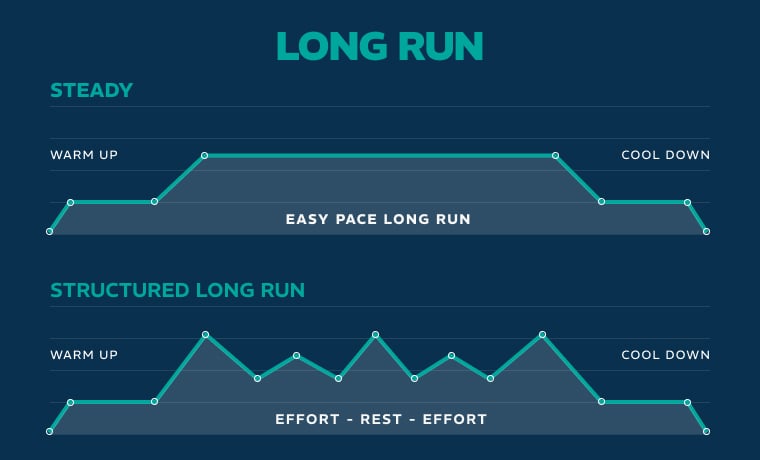
Starting with a longer warm-up is a great way to set yourself up for a strong main section. This might be 10–30 minutes of easy running, gradually easing into the session. How you approach the main portion of the run will depend on your experience and training goals.
For most runners, the bulk of a long run is completed at a steady, continuous pace. In some cases, particularly when training for longer distance events, the run may be broken into longer intervals of effort with easier running in between. Steady, easy efforts are more common, while structured long runs with intervals are typically reserved for more specific training phases.
Overall intensity should sit around a perceived effort of 4–6 out of 10. This allows your body to adapt without placing unnecessary stress on it. The effort should feel comfortably below race pace, while still being more structured than an easy recovery run.
A proper cool-down supports recovery by gradually lowering your heart rate and helping the body transition out of sustained effort.
Fuelling and Hydration
Fuelling and hydration are essential for a long run to prevent energy depletion and maintain glycogen levels throughout the workout. If not done correctly, this can impact your training for days to come.
Before Running
Fuelling for a long run starts the day before. Staying well hydrated and eating a balanced diet of carbohydrates and protein sets you up for success before you’ve even started. A carbohydrate-dense dinner helps top up energy the night before. Ideally try and eat this 2-3 hours before bed to allow for proper digestion. Some dinners I like to eat the night before long run include; Grilled chicken with rice and sweet potato or Pasta with a simple tomato-based sauce.
I often struggle to eat before longer efforts but it does make a big difference having something small but high energy. An easily digestible and high carbohydrate breakfast a couple of hours before is the best way to go about it. Also means that you can easily replicate this for any events you might end up doing. Breakfasts that have worked well for me include: Crumpets with Jam or Porridge with Banana and honey.
During Running
This is where specific running nutrition comes in. Energy gels are the most popular and common energy source during runs because they are measurable, easy to carry and easy to digest. Gels vary quite a bit based on carbohydrate levels, sodium, thickness and flavour. The main functional differences that I like to consider are density and capacity. How many carbs per serve and how thick the gels are to consume. A running gel can have anywhere from 20-90 grams of carbohydrates per serving. I generally aim for about 30-40 grams an hour on my long runs and sometimes more for race-specific sessions.
If you’re completely new to energy gels the key is to try some different ones and figure out what works for you and sits well in your stomach. A great running gel to start with is with SIS Energy Gels. They are easy on the stomach, easy to swallow and 'isotonic', meaning you don't need water to digest them.
Drink mixes, chews, lollies, dried fruits, honey and maple syrup are other popular fuelling sources used by runners on long runs.
After Running
Eating within 30-60 minutes of finishing your long run is key to kick-starting recovery. Restoring glycogen stores and replacing lost carbohydrates and replenishing electrolytes is essential for recovering properly. Smoothies as well as high carbohydrate and protein dense meals are great. Chocolate milk is my favourite post long run drink, as it provides a balance of protein for muscle repair and carbohydrates for energy replenishment, helping muscles recover faster.
Recovery
Recovery and preparation for your next run begin as soon as you finish your current one. Beyond fuelling and hydration, there are plenty of ways to support recovery and reduce the impact on your body. Gentle movement that promotes blood flow is especially beneficial on the same day or the day after a long run. I often try to get in a light swim. The natural compression and coolness of the water are excellent for muscle repair. A gentle walk or easy ride are also great low-impact options to help the body recover.
Most importantly, sleep is where the real recovery happens. Quality sleep allows glycogen stores to be replenished, supports natural muscle and tissue repair, and helps reduce inflammation. I personally use Pillar’s Triple Magnesium daily to support sleep quality and muscle recovery.
Clearing Up Long Run Misconceptions
One of the biggest misconceptions about long runs is that they’re meant to be hard. While there may be moments of effort, most of the session should feel controlled and sustainable.
Longer isn’t always better. More distance isn’t always necessary and could end up putting unnecessary stress on your mind. Going harder or longer too soon is where injury and burnout creep in.
Long runs don’t have to be reserved for Sundays. While Sunday is my preferred long run day, they can work just as well on Saturdays or even during the week, depending on your schedule. Sundays are popular because they’re often well placed around other training sessions and allow plenty of time for recovery afterward.

Make Long Runs Something You Look Forward To
One thing I’ve learned over years of running and from all the runners here at RunDNA is that long runs don’t have to feel serious or heavy. The more enjoyable they are, the more consistent you’ll be.
Here are a few simple ways to make your long run feel easier, lighter, and more sustainable:
Run with others
Long runs are always easier in company. Running with a friend or group helps the time pass faster, keeps the pace honest (and usually easier), and adds a social element that turns training into something you look forward to. Some of the best conversations happen mid-long run.
Change the scenery
A new route can completely change how a long run feels. Trails, coastal paths, or exploring a new Strava route can make distance feel shorter and keep your mind engaged. Variety is a powerful tool for motivation. I enjoy the Adelaide City Loop for a scenic and continuous route.
Keep the pace relaxed
Long runs should feel steady and conversational unless you’re doing a specific training session. If you’re constantly checking your watch or stressing about pace, you might be working too hard. Let the effort guide you, not the numbers.
Break it into chunks
Mentally, thinking about a full long run can feel daunting. Instead, break it into smaller sections. First 5km, the next gel, the next song, next effort. Before you know it, you’re most of the way through.
Use long runs as reflection time
For some runners, long runs are social. For others, they’re therapy. Music, podcasts, or running without distractions can turn them into valuable mental space, not just physical training.
The more enjoyable your long runs are, the easier they become a habit and that’s where real progress happens.
Best Long Run Shoes
A long run shoe needs to be cushioned, comfortable, durable, and provide some energy return. A super trainer blends these characteristics to strike the perfect balance between comfort and performance. I asked the team what they’re running in for long runs at the moment:
Matt - Nike Vomero Plus
The Vomero Plus feels durable and comfortable with a surprisingly lively feel for longer runs. It has the reliability of a daily trainer, but the ZoomX foam gives you extra bounce, making it feel fresh over longer efforts. The wide base keeps things stable and supportive as the distance builds.
Georgia - ASICS Megablast
Punchy and incredibly durable, the Megablast fits exceptionally well, which isn’t always a given with unisex shoes. It feels effortless from the first kilometre and stays lively even as runs push toward the two-hour mark, making it a great option for long runs with pace changes.

Jessie - Puma Mag Max 2
A supportive option that really shines on slower long runs. The wide base of the Mag Max 2 provides confidence and control, while the spacious toe box is ideal as feet start to swell over distance. The outsole is incredibly durable, and the cushioning stays consistent throughout the run. It doesn’t feel flat or dead late on.
Asher - ASICS Superblast 3
Highly versatile and reliable, the Superblast 3 is a great long-run shoe with plenty of cushioning and a soft but punchy feel underfoot. It’s responsive enough to lift the pace when needed, while still offering enough protection to offload my achilles and calves over longer efforts. A true workhorse that delivers long run after long run.
Rees - Mizuno Neo Vista 2
The Neo Vista 2 feels soft underfoot while still staying responsive, with a smooth and effortless ride that suits longer runs perfectly. The glass fibre plate adds structure and propulsion without feeling too rigid, helping the shoe roll smoothly through each stride and stay efficient as fatigue sets in.

About the author
Ed - Runner & Content Creator
I’m passionate about all types of running, road and gravel cycling, content creation, quality gear and the stories that follow effort and adventure. Triathlon and long distance road running are my current focus as I love pushing the boundaries of the body and mind.